
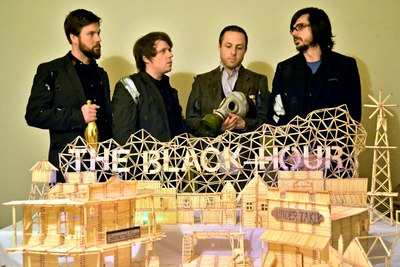
The weekend prior to Vacuity’s Southern Ontario tour, the band and friends spent the entire two days -with Emeri Schweigert (on the drums) and Paul McGough (slapping the bass) working until the sun came up the next morning – silk screening the CDs and putting the physical albums together. They jokingly called the whole project a sweatshop, the pay being pizza, and “only loosening our friends’ shackles every now and then, but no phones, and no leaving the premises”, said Greg Osborn, lead guitar player/amateur silk screener.
Their newest album, The Black Hour, is touched with the support of the band’s friends and family, somehow sewing together with the light at the end of the tunnel-esque feel of the music itself. The kick-ass alternative rock band from Kitchener, Onatrio started their tour on Tuesday, June 26th at the Casbah in Hamilton.
“It was a good place with good people, but there wasn’t many people there last night. We were expecting that because of various things we didn’t do but tonight is going to be good,” said Rob McFee, singer/keyboard player/guitarist.
Their CD release party at The Hideout in Toronto on June 27th definitely had a more hopeful turnout. The energetic crowd sang along to songs old and new. Jamie Usas manned the visual component of the band’s performance: a projection of images on a screen behind the band, harmonizing images of them performing with nostalgia film footage.
I sat down with Rob McFee and Greg Osborn, later joined by Emeri Schweigert, on The Hideout patio before their show and talked about the new album, touring, and a life of music. Throughout the interview, friends and fans came to share their excitement for the guys, and the modest musicians always had time to say hello and give thanks for the ongoing support these people give to them.
I came across your MySpace page and noticed under “bad influences” it said post-apocalyptic novels, can you tell me a bit about that and what exactly it means?
Osborn: I think what I meant when I said bad, I meant negative influences.
Mcfee: Not negative, dark.
Osborn: Rob and I read a lot and often it seems to happen we, when we’re entering creative mode, we’ll be drawing from books we pass around between us.
McFee: You end up hanging out more, and you’re in close quarters so obviously you talk about some cool things you just read and then everybody will pass the books around. For this album it was a lot of post-apocalyptic fiction.
Osborn: The Road was one of the books we passed around, and it’s a pretty grim novel.
McFee: Other albums have different things, it’s what we’re into at the time, and you inevitably end up drawing influences from whatever you’re into right?
Osborn: Some of the stuff on the album is dark, but I feel a lot of the dark talk makes me feel like it’s gloomy or something, there’s hope there.
McFee: We had a review; they said it was dark, melancholic but hopeful. I hear that too, I’m glad somebody else picked that out because I thought it was just gonna be dark for a while.
How would you describe your sound to someone who’s never heard your music before?
McFee: We have a lot of British influences. We used to be into Muse. We were into their first couple albums quite a bit and then they got a little interplanetary, so we didn’t listen to them as much. We get compared a lot to Radiohead but I don’t think we sound totally like them.
Osborn: It’s hard to say when you’re in the band. For this album, sound wise my mentality was like whatever works and whatever we want to do. Sound wise we’re pretty open to what we want. I’m sure if someone brought a Bieber riff, if that exists, we might shoot it down but you know there’s electronic instrumentation there’s guitar, rock stuff. It’s all over the map. But there seems to be some kind of thread of cohesion that runs through this album.
So you made your last album, At the Command of the Blanket Sky, available for free, why was that decision made?
McFee: We’re trying to grow a fan base and we were going on tour so we wanted to make sure that as many people as possible could get the music and everything else was secondary.
Osborn: It had been out for a while too before we made it available for free.
McFee: Yeah, it wasn’t off the bat.
Osborn: Some of our thinking was that it doesn’t cost us much to share digital files. It also doesn’t help us put any gas in the vehicle. It’s kind of a balancing act.
McFee: You have to have people hear the music and get into it. We’re not super well known so at the time we had to get people to hear the album so we didn’t want price to get in the way. At the shows we still sold CDs but the digital thing is great because it doesn’t cost you money just to make it available, it’s one of the great things about digital technology.
Osborn: There is a lot of copyright things going on right now legalistically and obviously our people want to come see music they enjoy. I can’t see the way forward is more copyright laws. If music could be available to everyone that would be awesome, but you have to have infrastructure to be able to make it. We were talking about a lot of these ideas, maybe spurring from those post-apocalyptic, massive paradigm shift concepts and then we just started talking about making the album available for free.
McFee: This time we just made the album really cheap. We did all the screening. Paul, he got into silk screening and a bunch of our friends and Emeri they screened most of the disks. We made it really cheap and did the stuff homemade.
Osborn: For a while we all lived in a house together. The jobs were mixed together so everyone is in their own space and Paul, I admire him greatly for this, he’ll make a matchstick mountain. Silk screening is meticulous and you have to have a great deal of patience, it’s a lot of cut and paste. I never went to that station in kindergarten so I was more like Paul’s assistant.
Schweigert: We had a lot of help for that; we had a big support group.
McFee: This tour is pretty posh. We’re only playing six dates in Ontario. We’ve been on some pretty long tours out west and some other not so long tours our east. Touring Canada is quite the experience because everything is so far apart.
Osborn: Thunder Bay on the map is like this far (stretches apart his thumb and pinky on his left hand) from Kitchener. But when you drive it’s like 16/20 hours.
McFee: It’s a 22-hour drive.
Osborn: We get to sleep in our own beds this time.
McFee: We went out west twice and one of the tours was seven weeks long and at the beginning we played three nights in a row and that’s like a 12-hour drive in between each one of those and when we were in Thunder Bay and it’s like winter up there in the spring. I mean at night you’re talking like minus 20; the crystal forest, there was ice rain. Touring was intense. We’re happy to go out west again but we need to develop more of a fan base out there before we really do that again.
How was the response from the crowd out there?
McFee: Oh they were great, people are so laid back out west, have you been there?
Yeah, I lived there for a bit and I agree, totally laid back and positive.
Osborn: Everyone would always say that and then actually seeing it, it does seem to have a more laid back vibe, and it’s so beautiful. There were a few times on the tour we’d have a show and then get a hotel that night and we’d have no show for a couple days. Rob did a pretty good job of making that not happen but it was inevitable. To be stuck in a place like Nelson, BC so beautiful you’re not stuck there so you almost don’t want to leave.
Schweigert: We had to do some repairs to the bus at that point because on the way up the mountain you blew up the muffler.
McFee: That’s another things about touring, you get real acquainted with your vehicle.
Schweigert: We knew that vehicle very well. It would overheat as you go up the hill, and then when you’re going downhill you put it in neutral and then just coast. You’re conserving gas too.
I was going to do the drive this year, but then decided to stay and go to Osheaga, have you guys been to that festival?
Schweigert: We’ve been there
Osborn: Who did we see? Who was headlining?
Schweigert: We saw Elbow, Coldplay was there.
McFee: There was somebody else I was excited about. Silver Starling, you should check them out.
Schweigert: Yeah, festivals are pretty fun.
Osborn: They’re fun, but they’re very trying because you’re out and you’re in the sun, you gotta bring a lot of water.
McFee: Some places don’t let you do that though, we went to Coachella, which is in the middle of the desert, and they wouldn’t let you bring in any water.
Osborn: They said they had water.
McFee: What they had, for like 20, 000 people like a little town or something, was one hose.
Osborn: Literally a garden hose that you can wait in line for like half the day and fill it up with warm water. Yeah, Coachella was really good though.
The band met at Preston High School in Cambridge, Ontario and have been playing together ever since. They’ve released 4 albums within the past eight years.
You can check out the band at the link below
You can also check a webisode from their tour right here.
Interview By: Stephanie DePetrillo
